Thermal expansion is important in long rail runs because unchecked movement causes real problems. A rail that cannot move with temperature changes may buckle, loosen fasteners, shift modules out of alignment, and create safety hazards on the roof. You see the effects of solar mounting rail thermal expansion most clearly on long spans, where small movements add up fast.
Installers, engineers, and project managers all face this issue. You can manage it with sound solar rail installation requirements, careful layout, and the right connections. This guide gives you practical ways to calculate movement and accommodate it before it becomes a callback.
Key Takeaways
-
Long solar rails expand and contract with temperature changes, causing movement that can damage the system.
-
Unchecked expansion can buckle rails, loosen fasteners, and misalign panels, leading to safety hazards.
-
Calculate thermal movement using a simple formula to determine the gap size needed for expansion.
-
Design rails with expansion joints and slotted connections to allow controlled movement and prevent stress.
-
Choose rail materials wisely: aluminum moves more than steel, so plan for extra gaps in aluminum rails.
Why Thermal Expansion Important in Long Runs
Thermal Expansion Basics
Every material grows longer as it warms and shrinks as it cools. This linear dimensional change is thermal expansion, and it affects nearly every metal in an array. Aluminum, the most common rail material, moves noticeably. The solar aluminum rail expansion coefficient is about 0.0000128 in/in/°F. Steel moves roughly half as much, at about 0.0000065 in/in/°F. Sunlight heats the metal by day, and night air cools it. The rails respond with a slow push and pull that repeats for decades.
You can express the movement with a simple relation: change in length equals the expansion coefficient times the original length times the temperature change. That relation explains most field problems, and it is why thermal expansion important checks belong in every layout review.
Why Long Runs Amplify Movement
Movement accumulates. A short span sheds a small amount of movement at each end. A long rail has nowhere to shed it. Total change scales directly with length, so doubling the span doubles the movement. A 100 ft aluminum rail grows about 1.56 inches over a 100°F swing. The same rail grows about 0.78 inches over a 50°F swing.
Long metal rails behave differently from short ones. Continuous aluminum profiles carry load across many supports, and continuous rail systems pass movement along the whole line. Installers who join continuous aluminum rails into one stiff line remove every chance to release stress. Continuous rails work well when the design gives them room to move.
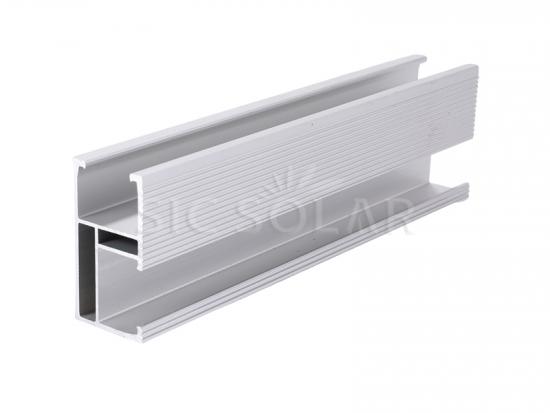
Array height adds another variable. Panels mounted higher above the roof catch more airflow underneath, and that ventilation changes how hot the rails run. Treat long rail runs exceeding 12 meters as a design case, not a routine span. The numbers make clear why thermal expansion important in long rail solar mounting.
Designers of solar mounting systems treat long rail runs as a separate case. Long rail solar mounting rewards a layout that plans for movement, and a long rail above that threshold needs a joint or a slotted connection.
Risks in Long Rail Solar Racking
Rail Buckling and Structural Stress
A rail that cannot move has to fight the temperature swing. The metal pushes against fixed connections, and those forces have nowhere to go. According to the Solar Rail & Module Mounting Guide (Section 6.3, Thermal Expansion & Gap Control), aluminum's high coefficient of thermal expansion causes cumulative movement in long rows to exceed an inch between winter and summer. The guide notes that racking designs specify maximum continuous rail lengths, typically 40–60 feet, before a thermal break is required. Install a single continuous rail beyond that limit, and the failure modes are structural buckling of the rail and damage to the mounted modules.
Buckling is the visible outcome. The rail bows, twists, or lifts away from its supports. Structural safety depends on keeping the load path predictable, and a bowed rail no longer carries load the way the engineer intended. You can prevent this outcome at the drawing stage. Plan the break, size the gap, and the rail stays straight through every season.
Fastener and Panel Damage
Impeded movement also works on the connections. Aluminum module frames and steel rails expand at different rates during daily temperature swings. This differential movement reduces clamp pressure across the joint even when the original installation torque was correct. The reduced clamp force permits micro-slippage at the connection. Over months, the joint settles and effective preload drops, a process known as torque relaxation. The load path then shifts from the designed friction-grip condition to a bearing and shear condition, which accelerates wear and raises the probability of fastener failure during storms.
Thermal expansion and contraction can cause loosening of connections over time in solar mounting structures exposed to environmental stresses.
Panel misalignment follows the same pattern. Designers already recognize this behavior in hardware. One aluminum alloy clamp system permits movement along the primary suspension cable, which shows that accommodation, not resistance, is the proven approach. Restrained movement can also distort roof or metal panels when the array transfers force into the building envelope.
These thermal expansion effects are predictable, and they are preventable. Good solar rail installation requirements call for correct torque, slotted connections, and joints at planned intervals. Treat every long rail solar racking layout as a system that needs room to breathe, and the hardware will hold its preload and alignment for the life of the array.
How to Calculate Thermal Expansion
Expansion Formula and Coefficients
You can predict movement with one simple relation. Change in length equals the coefficient of linear expansion times the original length times the temperature change, written as ΔL = αLΔT. Here ΔL is the change in length, α is the coefficient, L is the original length, and ΔT is the temperature swing. Keep units consistent and the result comes out in the same unit as your length.
Material choice drives the coefficient. Common aluminum alloys sit near 21–24 ×10⁻⁶/°C, while carbon steel falls in the 11–13 ×10⁻⁶/°C range. Aluminum therefore moves roughly twice as much as steel for the same span and swing. That gap matters on any long rail, because mixed-material connections see differential movement even when both parts start at the same temperature.
Worked Example
Take a 24 m aluminum rail and a 50°C temperature swing. Multiply 23 ×10⁻⁶/°C by 24 m by 50°C, and you get about 27.6 mm of movement. That figure is your minimum gap. A 30 m rail facing an extreme swing from -40°C to 80°C can move up to 31.2 mm, so the gap grows with both length and temperature range.
Manufacturers publish maximum rail lengths before a thermal break or gap is required, and you should follow those limits. Check the published limit for your long rail systems longer than 12 meters before you finalize the layout. Treat long rail runs exceeding 12 meters as a calculation case, and confirm the numbers for every long rail solar mounting project.
Design Strategies for Long Rail Solar Mounting
Joints and Slotted Connections
You control movement by giving it a path. Expansion joints, slotted connections, and sliding clamps let a rail grow and shrink while staying attached. Use slotted mounting holes on at least one end of each cross-bar, so the rail can expand and contract with thermal growth. Alternatively, mount towers with slight clearance so the rail bolt can slide within the rail channel. Slotted holes handle longitudinal and lateral movement, sliding clips permit relative movement between cladding and structure, and flexible brackets prevent stress concentration, buckling, or warping. Even with a slot present, the connection must still develop the required clamping force when you tighten the bolt to specification.
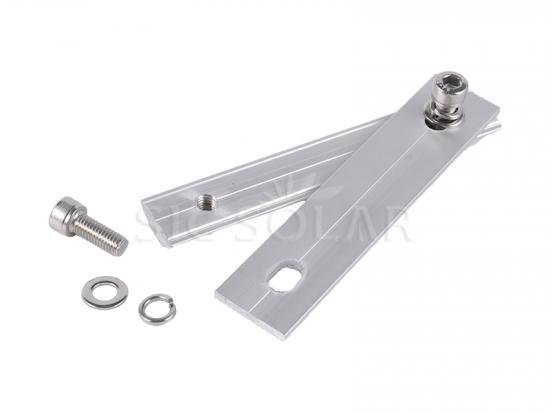
Anchor rigidly at the center and treat the run as two free-moving half-segments. A 60 ft aluminum run in a climate ranging from about 10 °F to about 110 °F sees a 120 °F swing. That works out to roughly 1.1 in of total length change. Each half grows and shrinks about 0.55 in at its outer end. Detail a concealed expansion joint or sliding bracket near each end with axial slip capacity exceeding that travel plus margin. Pair it with small visible gaps of about 1/8 in in cover trim.
Clarify one point before you finalize the layout. Thermal expansion gaps are primarily needed for side-to-side movement, not up-and-down movement. Metal roof panels must also be allowed to move thermally. A metal roof solar pv system performs best when the cladding and the array each move on their own path.
Material Selection and Layout
Material choice sets the size of the problem. Aluminum moves nearly twice as much as steel for the same span and swing. In high-temperature zones, specify alloys with low thermal expansion. For freeze-thaw conditions, higher-strength grades such as 6005-T6 or 6061-T6 better resist fatigue. High-strength aluminum alloys with enhanced thermal stability are emerging for solar mounting.
Layout planning reduces stress at connections. Short rail lengths naturally minimize thermal expansion effects compared with continuous rail systems. Ask four questions of any design:
|
Thermal Expansion Consideration |
Design Evaluation Question |
|---|---|
|
Rail Splice Design |
Does the system allow controlled movement? |
|
Rail Length |
How are long rail runs managed? |
|
Attachment Strategy |
Are loads distributed effectively? |
|
Expansion Guidance |
Does the manufacturer provide clear recommendations? |
Good solar rail installation requirements cover all four. Check the published limits for your long rail solar racking, and confirm the gap sizing for every long rail solar mounting project. Sound solar mounting systems pair expansion joints with sliding supports, and that combination delivers reduced thermal expansion stress across the whole assembly. Review your solar mounting rail thermal expansion figures and your solar aluminum rail expansion allowance before the next install.
Solar Mini Rail vs Full Rail
Performance and Code Compliance
The solar mini rail vs full rail choice starts with how each option carries load. A solar mini rail system attaches modules close to the roof sheet, so it relies on the roof deck for support. A full rail mounting system spans between attachment points and carries load through the rail profile itself. Both approaches meet structural requirements when you size them for the site.
Code compliance depends on local conditions. The solar mini rail vs full rail decision must account for the design codes in your region.
|
Region |
Conditions |
Applicable Code |
Thermal Expansion Requirement |
|---|---|---|---|
|
Southwest Deserts |
Extreme Heat & Wind |
IBC / ASCE 7 Ch 26 |
Thermal expansion mitigation (alongside deep foundations for sandy soils) |
Check solar rail installation requirements for your jurisdiction before you finalize either layout. Account for solar mounting rail thermal expansion and solar aluminum rail expansion in the design, especially on long rail runs.
Cost and Best-Fit Applications
Cost favors the solar mini rail system in many projects. Mini rails use less aluminum per meter, ship lighter, and install faster. The solar mini rail vs full rail cost gap shows up in labor and logistics as much as material.
Using 3 full rails costs more money and requires more roof penetrations. Adding extra roof anchors (e.g., every 4 ft instead of 6 ft) is still less money and effort than adding an extra rail.
-
Material cost: mini rails consume less aluminum per meter.
-
Shipping cost: lighter packaging lowers freight.
-
Labor cost: lighter rails speed up handling.
Fit matters more than price. Choose mini rails for trapezoidal metal roofs, small to medium projects under 500 kW, and moderate load conditions. Choose a full rail solar mounting system for high snow loads, large spans, complex layouts, or projects above 1 MW. Standing seam roofs need non-penetrating seam clamps instead.
SIC SOLAR supplies rails, clamps, hooks, and grounding lugs across residential, commercial, and utility-scale work. Its solar mounting systems give installers both paths, and its solar mounting system components suit long rail solar racking and long rail solar mounting alike. Compare continuous rails against segmented layouts, then pick the solar mini rail vs full rail option that fits your roof.
Thermal expansion is a predictable force. Thermal expansion important checks belong in every layout. Long rail runs demand deliberate design to prevent buckling, loosening, and panel damage. Calculate movement first. Then plan expansion joints and slotted connections that let rails slide. Match rail materials to the application. Anchor rails at the center and let both rail ends move. These steps protect structural safety on every long rail solar mounting project. Good solar mounting systems simplify this. Review your solar mounting system layout today. Clamp rails firmly. Check rails, joints, and expansion gaps before the next install. Inspect rails at each rail splice, anchor, and clamp. A short review prevents costly repairs.
FAQ
How much movement should you expect in a long rail run?
Movement scales with length and temperature swing. A 100 ft aluminum rail grows about 1.56 inches over a 100°F swing. Check published limits for continuous rails before you finalize the layout.
Do expansion gaps apply to vertical movement?
No. Thermal gaps mainly handle side-to-side movement. Rails still need firm clamping up and down. Slotted connections let rails slide lengthwise while clamps hold rails down. Metal roof panels also need room to move. Segmented rails handle this well.
When should you add a thermal break?
Follow the manufacturer's maximum length. Many designs call for a break on continuous rails beyond a set span. Treat runs over 12 meters as a design case. Split long rails at the center and let both ends move. Segmented rails avoid the issue entirely.
How do slotted connections help?
Slots give rails a controlled path to grow and shrink. Tighten bolts to spec so rails keep clamp force. Pair slots with expansion joints on long rails. Aluminum rails and steel rails behave differently. Review solar rail installation requirements for your jurisdiction.
Does rail material change the gap size?
Yes. Aluminum moves about twice as much as steel. Mixed-material connections see differential movement. Account for solar aluminum rail expansion in your gap sizing, and check solar mounting rail thermal expansion figures for every layout.