current location : Home » categoires :
AC-Coupled vs DC-Coupled PV Energy Storage System-How To Choose For Solar Power Plant?
AC-Coupled vs DC-Coupled PV Energy Storage System-How To Choose For Solar Power Plant?
As project profitability relies more on energy shifting — storing daytime solar power for evening peak-price consumption — adding battery energy storage is no longer optional.
Another practical challenge for many solar projects is limited grid connection capacity. When upgrading existing PV assets, developers hope solar arrays and battery storage can share grid access capacity to maximize the utilization of existing infrastructure.
Under such circumstances, a critical design decision emerges: should you build an AC-coupled or DC-coupled solar energy storage station?
1. What Are AC-Coupled and DC-Coupled Solar Storage Solutions?
The core distinction between AC-coupled and DC-coupled systems lies in where solar power and battery power converge within the system.
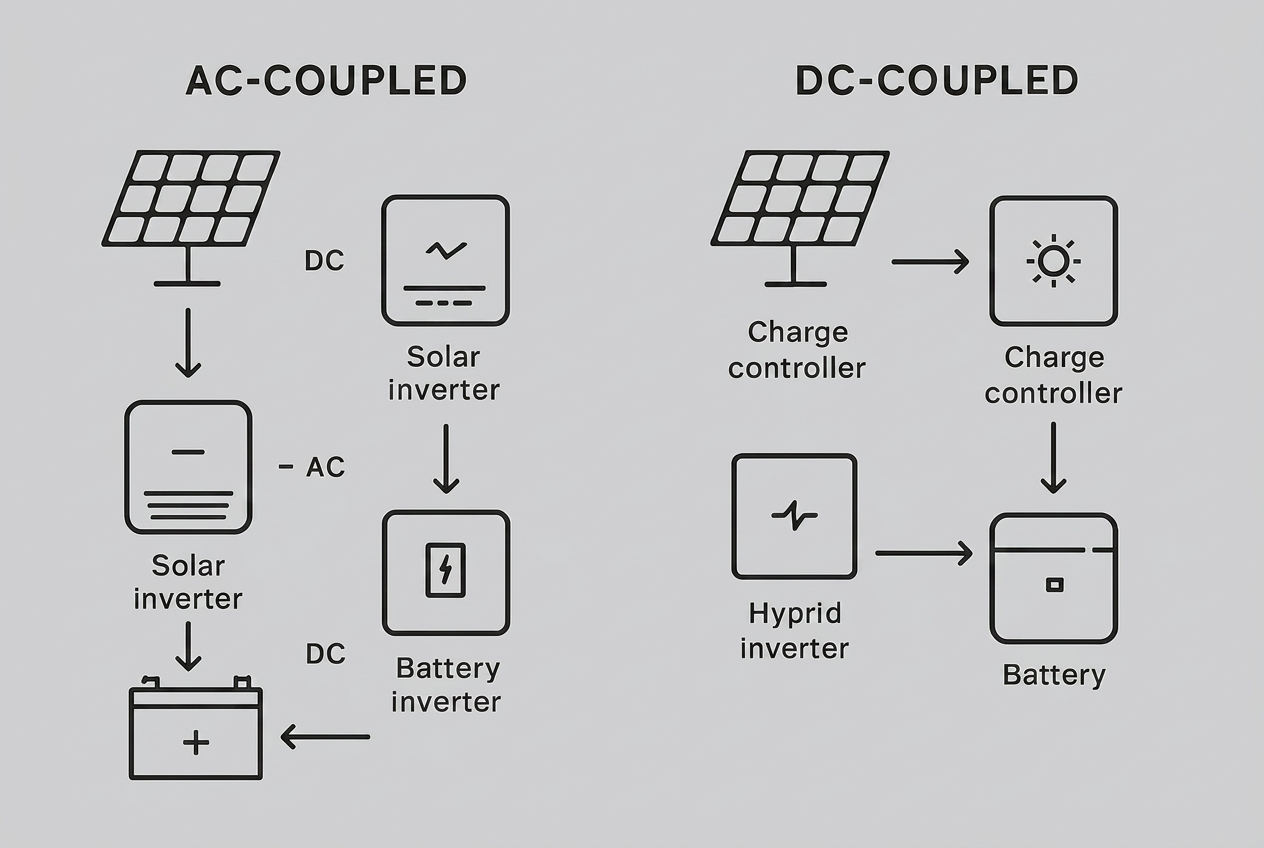
1.1 AC-Coupled Solar Energy Storage
AC-coupled solution has long been the mainstream choice for large-scale ground-mounted solar power plants. In an AC-coupled system, solar panels and battery storage operate as two independent systems. Solar panels connect to ongrid solar inverters to convert DC into AC power. Meanwhile, energy storage batteries connect to a separate Power Conversion System (PCS). The two independent energy branches converge on the AC side before sharing one common grid connection.
Energy storage can be scheduled as a standalone asset, which brings huge flexibility for complex multi-source power stations and retrofit projects on existing solar farms.
1.2 DC-Coupled Solar Energy Storage
For DC-coupled solutions, solar panels and lithium batteries meet on the DC side. Solar DC power flows into a hybrid inverter, which manages both solar input and battery charging & discharging. Only one inverter handles DC-to-AC conversion for both PV and batteries before exporting power to the grid.
There is no separate independent PCS for the battery bank, creating a more compact system layout, which makes DC-coupled setups popular for residential, commercial rooftop PV storage systems.
2. Main Advantages & Limitations of Two Storage Configurations
2.1 AC-Coupled System: Pros and Cons
Advantages
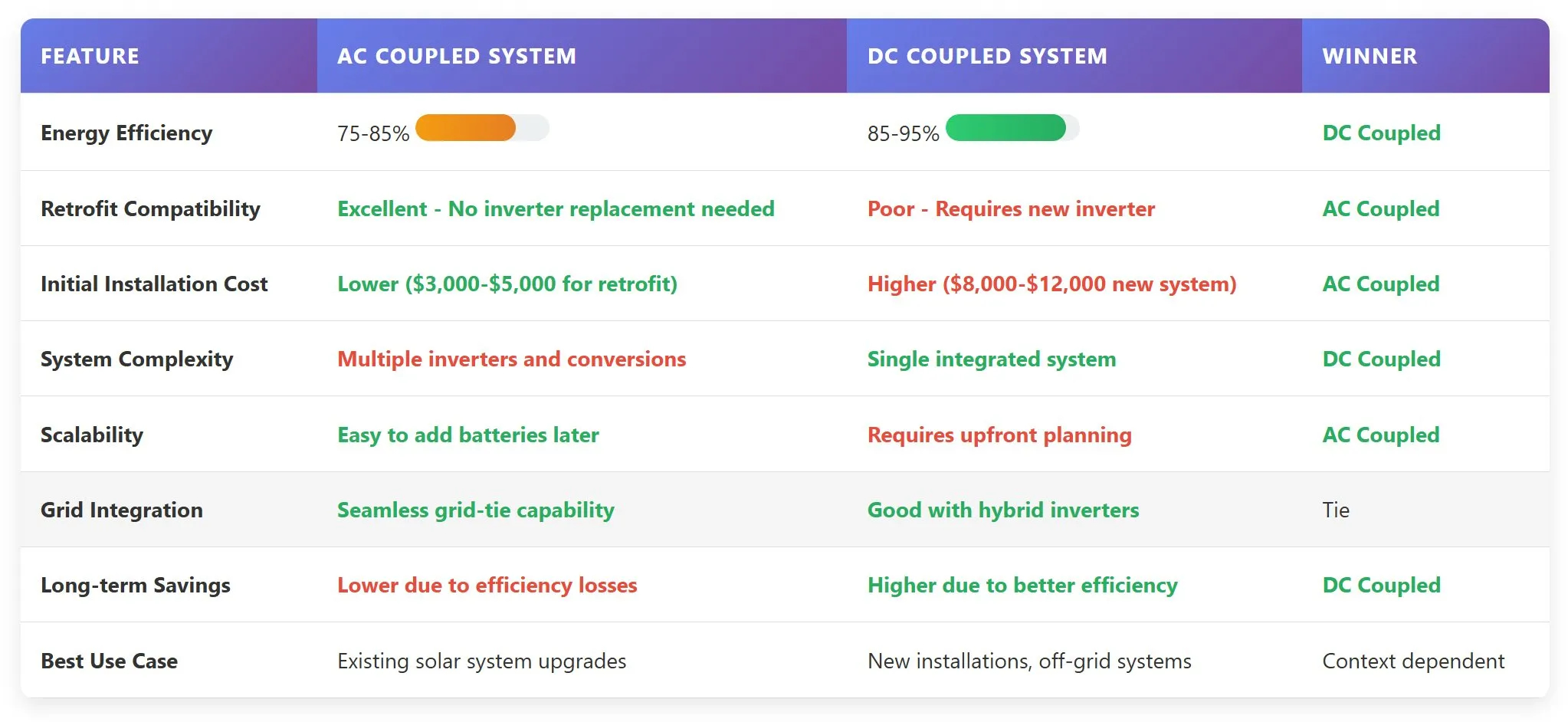
1) Perfect for retrofitting existing solar stations. No modification is required for original solar inverters; you only add battery cabinets and independent PCS.
2) High operational flexibility. The energy storage system can work without the PV array, supporting grid peak shaving, backup power and frequency regulation services independently.
3) Easy capacity expansion. Solar capacity and battery storage capacity can be expanded separately without interfering with each other.
Disadvantages
1) Extra power conversion losses. Energy will go through two rounds of AC/DC conversion during charging and discharging, leading to slightly lower round-trip efficiency.
2) Higher initial investment for large capacity systems, requiring separate PCS equipment for the battery system.
2.2 DC-Coupled PV Storage: Pros and Cons
Advantages
1) Higher energy efficiency. Solar DC power can directly charge batteries, avoiding redundant AC-DC conversion losses.
2) Simplified system structure. Only hybrid inverters are used, reducing the quantity of electrical equipment and saving space, especially ideal for limited rooftop areas.
3) Lower equipment cost for new small-to-medium solar storage projects.
Disadvantages
1) Not suitable for most existing solar plant retrofits. You usually need to replace original standard solar inverters with hybrid inverters.
2) Restricted expansion flexibility. PV array scale and battery capacity are limited by the rated power of hybrid inverters.
3. How to Choose Between AC-Coupled and DC-Coupled PV Energy Storage
After understanding their characteristics, you can select the appropriate architecture according to your project type.
3.1 Choose AC-Coupled Solution If You Meet Any Conditions
--You plan to add energy storage to an already operational existing solar power station;
--The project requires flexible independent scheduling of battery storage for grid auxiliary services;
--You are developing large-scale ground-mounted solar farms, medium & high voltage commercial power stations;
--You expect to expand solar capacity or battery capacity at different stages in the future.
3.2 Choose DC-Coupled Solution If You Meet Any Conditions
--It is a brand-new rooftop solar + storage project for households, small factories and commercial buildings;
--Maximizing energy utilization efficiency is your top priority;
--Installation space is limited, and you hope to minimize the number of electrical devices on site;
--Your project does not require frequent independent off-grid or auxiliary grid operation of the battery system.
4. Summary
There is no universal “better” solution between AC-coupled and DC-coupled solar energy storage systems. The optimal design fully depends on whether your project is new construction or retrofit, project scale, available site space and long-term operation targets.
For existing solar assets facing power curtailment, AC-coupled storage remains the most practical, flexible upgrade route.
For newly built small and medium rooftop PV storage projects, a well-designed DC-coupled system can deliver better energy efficiency and cost performance.
If you are still unsure which configuration matches your solar power plant, welcome to contact our professional engineering team can provide customized AC/DC coupled solar storage technical solutions according to your site conditions.
Questions and Answers
1. Can I mix AC-coupled and DC-coupled storage on the same PV site?
This is rarely recommended for standard projects. Mixed topologies introduce complicated energy management logic to your EMS and increase control coordination risks.
If you plan phased expansion—such as adding storage to an existing DC-coupled rooftop system at a later stage—an independent AC-coupled BESS is usually the more maintainable choice.
Most utility and commercial developers stick to one unified topology to simplify operation and maintenance.
2: Which topology delivers better efficiency in the actual operation?
Under ideal self-consumption scenarios for newly built rooftop plants, DC-coupled setups generally achieve higher efficiency by eliminating one round of AC-DC conversion.
However, AC-coupled BESS suffers less efficiency penalty if the storage system often runs without PV generation.
Site load profiles and operating modes, rather than topology alone, are the decisive factors.
3: Is an AC-coupled system more expensive to operate long-term than DC-coupled?
For new-build solar+ battery storage, DC-coupled architecture reduces conversion losses and yields higher long-term energy savings.
For retrofits of existing operational PV plants, switching to DC-coupled requires replacing all original solar inverters. The huge upfront change cost often outweighs efficiency gains over many years.
In this scenario, a well-designed AC-coupled solution delivers better overall economic returns across the project lifecycle.